
CASE STUDY . 01. TRANSFORMATION LEADERSHIP
Nine regional brands. One six month deadline. And no UX function yet.
The mandate was the launch. The harder problem was the function underneath it.
A $353M omnichannel mandate. I was building the UX team and shipping the launch in the same six months. Two parallel work streams. Three executive partnerships.
ROLE
ROLE
Head of User Experience
COMPANY
Reece USA
YEAR
2021- 2024
PARTNERS
CIO . CMO . Product . Engineering

THE OPPORTUNITY
A distributor with nine regional brands needed one digital strategy.
Reece had brought nine regional brands under one umbrella in the US. The result was fragmented journeys, siloed operations, an inconsistent brand experience and no design function to hold the customer view across any of it.
The launch was urgent. Six months to ship a digital commerce platform serving HVAC and Plumbing customers. But the launch was only the opening chapter. As the company continued acquiring businesses through 2021-2024, the unification work had to run alongside everything else.
BUILDING THE FOUNDATION
The first UX function at Reece, built for ecosystems, not features.
I established the first UX function at Reece during the pandemic by hiring a mixture of senior expertise and emerging talent, a team built to span research, design, testing and service design. I introduced service blueprinting and journey mapping as the operating model, shifting the question across the organization from 'What does this screen do?' to 'What is the system around it?'
The operating rhythm mattered as much as the talent. I set up cross functional collaboration sessions with Product, Engineering, Marketing and C-suite stakeholders. Design reviews, planning workshops, and decision forums gave UX a seat at the table from the first conversation, rather than the last review.

RUNNING TWO WORK STREAMS IN PARALLEL
Six months. Two missions. One design team.
The commerce launch and the warehouse apps couldn't wait for each other. I divided the team into two parallel work streams sharing one design view, common review, common research, one service blueprint as the spine.
Dual track Agile held it together. Research and design ran as parallel streams on the same Jira board, both feeding delivery. Two cadences, one customer ecosystem.
The harder leadership move was not running two work streams. It was making sure both teams were designing for the same customer at the same time.
DESIGNING FOR EVIDENCE
Funnels built in, not bolted on.
The launch couldn't be a one time event. To make the new platform a foundation, I worked with the marketing analytics team to instrument the experience with behavioral funnels from day one.
The design team could see where customers paused, dropped off, or converted across the journey, and iterate based on real signal rather than guesswork. The platform shipped with measurement baked in.
THE CMO PARTNERSHIP
From nine regional brands to one experience.
Across 2021-2024, as Reece continued to acquire businesses, the brand unification work was never a single project. It was a recurring strategic conversation with the CMO. I partnered with the CMO on the customer facing side: how each regional brand was experienced today, what the Reece brand needed to deliver to keep that loyalty, and how to move customers across without breaking it.
The service design lens mattered here. Brand isn't a logo. It's the sum of how a customer experiences a company across every touchpoint. We journey mapped each regional brand to see what the customer relationship was actually built on, then we designed the migration. The email sequences, the branch transitions, and the digital handoffs that moved customers into the Reece relationship without breaking the trust they had built with the regional brand.
THE OMNICHANNEL FUTURE BLUEPRINT
Three customers. One future blueprint.
The Bath & Kitchen division was the most strategically ambitious work. The vision was an omnichannel experience that connected the showrooms and the screen, designed for three bullseye personas:
The homeowner
Exploring possibilities and making the biggest aesthetic decision in their home.
The contractor
Balancing schedule, budget, and what's actually installable.
The Reece team member
Holding all the context and serving as the trusted guide.
I led the service design work that produced the future blueprint.
A co-designed view of how all three personas would interact online and in the showroom for the years ahead. We mapped how each persona discovered, planned, decided, and bought, and where their journeys intersected. The blueprint became the strategic artifact that aligned merchandising, technology, and store operations on a shared future state.


THE CIO PARTNERSHIP
Three months on the branch floor before designing anything.
The CIO's vision was frontline empowerment. Apps that gave branch staff and drivers the tools to do their jobs more efficiently. A vision needs a design that survives contact with reality. Before the team designed a single warehouse app, I spent three months on the branch floor, counting inventory, riding routes, watching the work happen.
The pain points were invisible from a conference room and obvious from the warehouse floor. The apps came later. The listening came first.

The immersion shaped four role specific apps the team built:
Inventory App
Simplified cycle counts, reducing discrepancies by 39%
Picking App
Streamlined order fulfillment and minimized errors
Counter POS
Reduced reliance on product memorization, improving service speed.
Driver's App
Improved delivery route planning, boosting on time performance by 15%
Each app started with a specific moment of friction I had watched happen.
DESIGNING REECE'S FIRST AI EXPERIENCES
Three features. One principle: design for the moments the system is least certain.
Alongside the commerce and operations work, I designed Reece's first AI powered experiences.
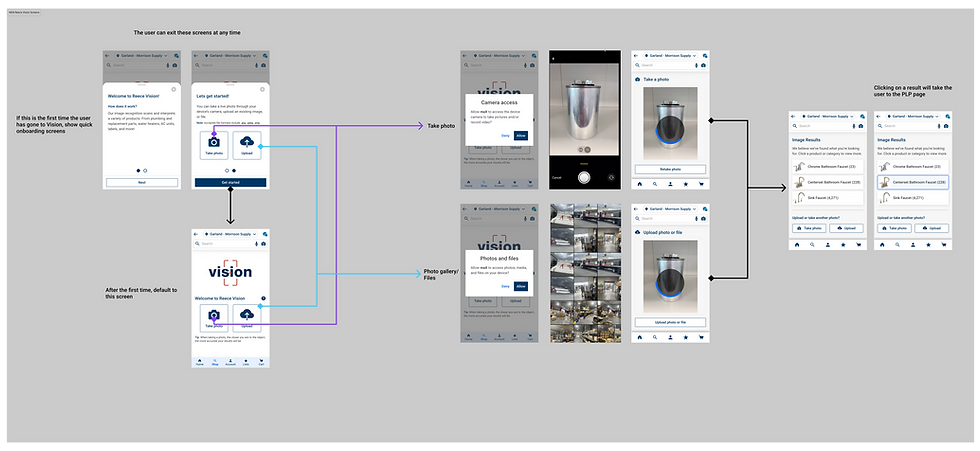
Reece Chat and Reece Vision brought natural-language search and computer-vision part identification into the maX mobile app for customers. A ServiceNow chatbot served 1500 employees across HR and IT. The same instinct ran underneath all three: design for the service, not the screen, and design hardest for the moment the system is least certain.
I've expanded on what these experiences taught me and how the design problem flipped with LLMs in a separate case study.
THE IMPACT
Measurable growth. A design capability built to keep delivering it.
$353M
in digital sales within six months
92%
customer satisfaction score
39%
reduction in inventory discrepancies
23%
increase in mobile feature adoption
19%
improvement in mobile retention
15%
improvement in on time delivery
Beyond the numbers, the work left a UX function that could keep delivering after the launch. The team I built was equipped to take the next acquisitions, the next platform iterations, and the next strategic conversations without needing the same scaffolding I had to put up at the start.
THE REFLECTION
Design leadership at this scale isn't about a single brilliant move. It is about holding multiple horizons at once, the launch, the acquisitions, the frontline, the future, and making sure the team and the customer are at the center of all of them.